
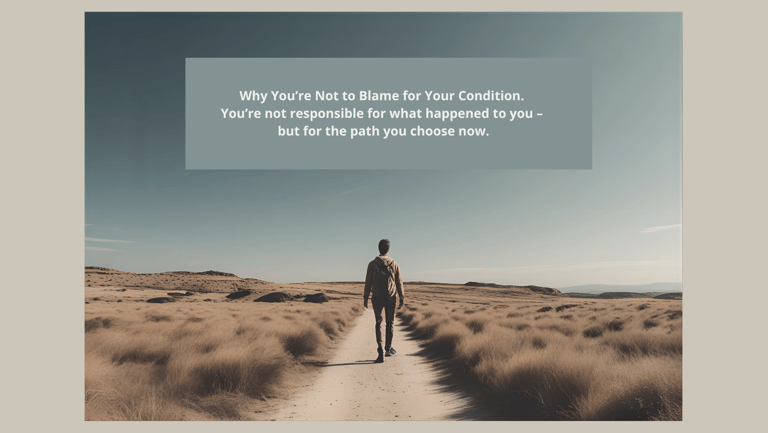
Why You’re Not to Blame for Your Condition
"You’re not responsible for what happened to you – but for the path you choose now."
Guilt – Your Unnecessary Companion
Guilt often appears out of nowhere: “I should have done more,” “It’s my fault I burned out.”
But these thoughts aren’t the truth. And above all: it’s not your fault.
Why You’re Not to Blame
Our brain is wired to search for explanations – even when they’re misguided.
Guilt often simply signals: something was extremely stressful – and your mind is trying to make sense of it. Living in a pressure-driven society and constant stress (e.g. from burnout, crisis fatigue, overwhelm) often leads you to take the blame – even though your condition was objectively caused by external factors.
Why Guilt Is So Sticky
Your mind turns it into a guilt complex:
You (often unconsciously) take on responsibility – which intensifies shame and self-criticism.
That, in turn, strengthens negative feelings like anxiety or depression – and blocks your recovery.
Common Questions:
Why do I feel guilty when I’m burned out?
Because you think, “I could’ve prevented this.”
But guilt isn’t a solution – it’s an obstacle to healing.
How do I stop blaming myself?
Start by noticing your guilt, gently questioning it, and replacing it with realistic thoughts.
Is it my fault that I feel this way?
No. Your condition is the result of overwhelming situations – your body simply sent a signal.
5 Steps to Let Go of Guilt
Acknowledge Without Self-Judgment
“I feel guilt” does not mean “I am guilty.” Observe without blame.Fact-Check Your Thoughts
Write down:What happened?
What external factors were involved?
Could you have realistically changed anything?
Find a New Perspective
Example: “I did the best I could” or “I deserve rest and a new beginning.”Practice Mindfulness Daily
Techniques like conscious breathing, reflection, or journaling keep your mind from spiraling into guilt loops.Set Boundaries & Ask for Help
Say “no” to overwhelming demands. Talk to someone you trust or seek support (CBT-based methods are highly effective).
Personal Clarity Instead of Self-Blame
Your guilt isn’t real – it’s the echo of a society that constantly pushes us to go faster, do more, be better.
Your body stopped in time. Now is the moment to say thank you – and truly take care of yourself.
You are not to blame – but you can decide what happens next.
👉 Get my freebie and learn how to escape the hamster wheel step by step – without pressure, without prior knowledge. Grab your freebie now & start your new path
Final Thoughts
Guilt is often a deceptive feeling that paralyzes you.
You are not responsible for burning out – you’re a victim of overload.
Step-by-step practices can help dissolve guilt.
You have the right to heal – and to forgive yourself.
Guilt – Your Unnecessary Companion
Guilt often appears out of nowhere: “I should have done more,” “It’s my fault I burned out.”
But these thoughts aren’t the truth. And above all: it’s not your fault.
Why You’re Not to Blame
Our brain is wired to search for explanations – even when they’re misguided.
Guilt often simply signals: something was extremely stressful – and your mind is trying to make sense of it. Living in a pressure-driven society and constant stress (e.g. from burnout, crisis fatigue, overwhelm) often leads you to take the blame – even though your condition was objectively caused by external factors.
Why Guilt Is So Sticky
Your mind turns it into a guilt complex:
You (often unconsciously) take on responsibility – which intensifies shame and self-criticism.
That, in turn, strengthens negative feelings like anxiety or depression – and blocks your recovery.
Common Questions:
Why do I feel guilty when I’m burned out?
Because you think, “I could’ve prevented this.”
But guilt isn’t a solution – it’s an obstacle to healing.
How do I stop blaming myself?
Start by noticing your guilt, gently questioning it, and replacing it with realistic thoughts.
Is it my fault that I feel this way?
No. Your condition is the result of overwhelming situations – your body simply sent a signal.
5 Steps to Let Go of Guilt
Acknowledge Without Self-Judgment
“I feel guilt” does not mean “I am guilty.” Observe without blame.Fact-Check Your Thoughts
Write down:What happened?
What external factors were involved?
Could you have realistically changed anything?
Find a New Perspective
Example: “I did the best I could” or “I deserve rest and a new beginning.”Practice Mindfulness Daily
Techniques like conscious breathing, reflection, or journaling keep your mind from spiraling into guilt loops.Set Boundaries & Ask for Help
Say “no” to overwhelming demands. Talk to someone you trust or seek support (CBT-based methods are highly effective).
Personal Clarity Instead of Self-Blame
Your guilt isn’t real – it’s the echo of a society that constantly pushes us to go faster, do more, be better.
Your body stopped in time. Now is the moment to say thank you – and truly take care of yourself.
You are not to blame – but you can decide what happens next.
👉 Get my freebie and learn how to escape the hamster wheel step by step – without pressure, without prior knowledge. Grab your freebie now & start your new path
Final Thoughts
Guilt is often a deceptive feeling that paralyzes you.
You are not responsible for burning out – you’re a victim of overload.
Step-by-step practices can help dissolve guilt.
You have the right to heal – and to forgive yourself.
© 2025. All rights reserved.
LEGAL NOTICES: